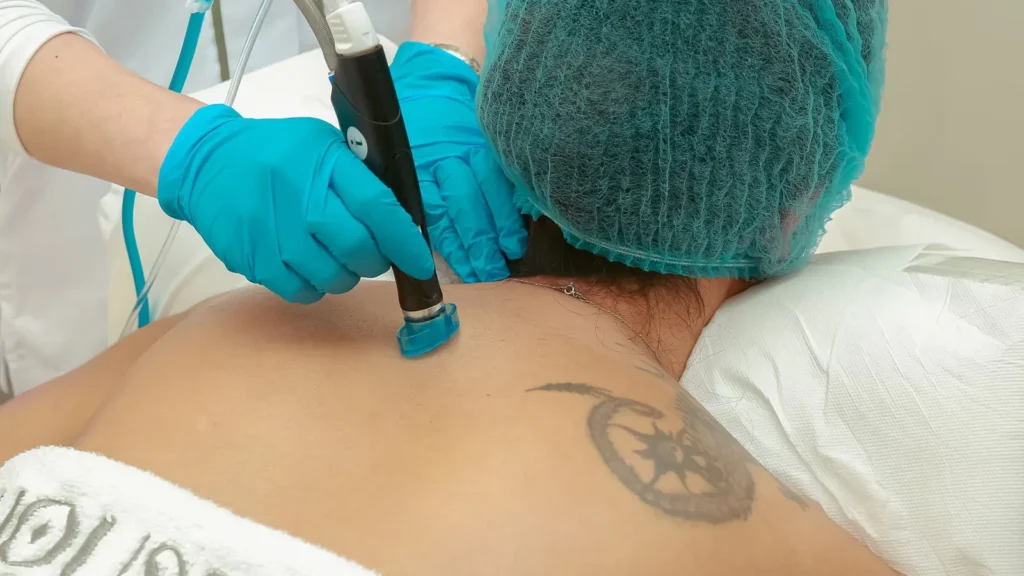
Most tattoos need about 6–12 laser sessions to fade substantially, spaced 6–8 weeks or more apart, so a full course often takes a year or longer. Small, black or amateur tattoos may need fewer; large, dense or colourful tattoos may need more. At Envisage Cosmetic in Norwest, a nurse assesses your tattoo and estimates your sessions at a free consultation.
Summarise this article with AI
The short answer: a range, not a fixed number
No clinic can promise an exact number of tattoo removal sessions, because every tattoo holds a different amount of ink, in different colours, in different skin. What a practitioner can give you is a realistic range after looking at the tattoo. For many professional tattoos that range is 6–12 sessions for substantial fading, and some need more.
The table below is a rough guide only. Your own estimate comes from an assessment of your tattoo and skin.
| Type of tattoo | How many sessions it usually needs |
|---|---|
| Small amateur or home-made tattoo | Often fewer than a professional tattoo, because less ink was used |
| Professional black tattoo | Commonly 6–12 sessions for substantial fading |
| Large, dense or heavily shaded tattoo | Often at the higher end of the range, or beyond it |
| Multi-coloured tattoo | More sessions; some colours may fade but not clear completely |
| Cosmetic tattoo (brows, liner, lips) | Small area, but needs a patch test, as some pigments can darken (see our guide to eyebrow tattoo removal) |
| Fading for a cover-up | Usually fewer sessions than full removal |
Why tattoo removal takes several sessions
Tattoo removal takes several sessions because the laser does only half of the work; your body does the rest. Tattoo ink sits in the dermis as particles too large for the immune system to carry away. A tattoo-removal laser sends very short, high-energy pulses into the skin, and the ink absorbs that energy and shatters into smaller fragments.
Over the following weeks, immune cells collect those fragments and remove them through the lymphatic system. Each session can only break up part of the ink, mostly in the upper layers, and the deeper ink is reached in later sessions. That is why fading happens step by step, and why a tattoo looks a little lighter after each round rather than disappearing at once.
At Envisage Cosmetic, laser tattoo removal is planned as a course, with your progress reviewed at every visit so the plan can be adjusted.
The factors that decide your number of sessions
Your number of sessions depends mostly on your skin type, where the tattoo is, its colours and how much ink it holds. Some clinicians use a scoring system such as the Kirby-Desai scale, which adds up points for these factors to estimate a session range. It is a useful planning tool, but it is still an estimate, not a promise.
| Factor | Fewer sessions | More sessions |
|---|---|---|
| Skin type | Fair skin, where the laser can target ink with less risk to the skin’s own pigment | Darker skin, which needs gentler settings and longer gaps to protect against pigment changes |
| Location | Head, neck, chest, upper arm and back, with good circulation | Hands, fingers, lower legs, ankles and feet |
| Ink colour | Black and dark blue | Green, light blue, yellow, white and fluorescent inks |
| Amount of ink | Fine lines, light shading, amateur work | Solid fill, heavy shading, professional saturation |
| Layering | A single tattoo | A cover-up tattoo over an older one |
| Scarring | Smooth skin | Raised or scarred tattoo skin |
| Age of the tattoo | Older tattoos, where some ink has already broken down | Newer tattoos with fresh, dense ink |
| General health | Non-smoker, active, well | Smoking or conditions that slow healing |
Your goal also matters. Lightening a tattoo enough for a tattoo artist to cover it usually takes far fewer sessions than aiming for clear skin.
How far apart sessions should be
Tattoo removal sessions are usually spaced at least 6–8 weeks apart, and often longer. This gap gives the immune system time to clear the shattered ink and gives the skin time to heal fully. Some practitioners recommend 8–12 weeks or more, particularly for darker skin types or areas that heal slowly.
Booking sessions closer together does not speed up removal. The ink that has already been broken up is still being cleared, and treating skin that has not fully recovered raises the risk of blistering, scarring and pigment changes. A longer gap is often a better use of each session.
How long a full course takes
The length of a course is roughly the number of sessions multiplied by the gap between them. The table shows the time from the first session to the last at common intervals. It is arithmetic, not a forecast of your result.
| Number of sessions | 6 weeks apart | 8 weeks apart | 10 weeks apart |
|---|---|---|---|
| 4 | About 4 months | About 5.5 months | About 7 months |
| 6 | About 7 months | About 9 months | About 11.5 months |
| 8 | About 10 months | About 13 months | About 16 months |
| 10 | About 12.5 months | About 16.5 months | About 21 months |
| 12 | About 15 months | About 20 months | About 25 months |
Fading also continues for several weeks after the last session, as the body keeps clearing ink.
Recovery after each session: a timeline
After each session, most people see redness and swelling for a few days, with possible blistering and scabbing in the first two weeks.
| When | What is common |
|---|---|
| Same day | Whitening of the tattoo (frosting) that settles within about 30 minutes; redness, swelling and a sunburn-like feeling |
| Days 1–3 | Swelling settles; blisters may appear and should be left alone |
| Week 1–2 | Blisters dry and scabs form and fall off; the skin may look pink |
| Weeks 2–4 | The skin settles; the tattoo looks slightly lighter |
| Months 1–3 | Gradual fading continues as ink is cleared; time for the next session |
What happens at each session, step by step
- Review. The practitioner checks how the tattoo responded last time and that the skin has fully healed. Photos help track progress.
- Protection. You and the practitioner wear protective eyewear.
- Cooling. The area may be cooled to make treatment more comfortable.
- Treatment. The laser passes over the tattoo in short pulses. Most people feel a sharp snapping or stinging sensation. A small tattoo may take only a few minutes.
- Dressing and aftercare. A soothing ointment and dressing are applied, and the next session is planned.
Full removal vs fading for a cover-up
Fading for a cover-up usually takes fewer sessions than full removal, because the goal is only to lighten the old design enough for new ink to cover it.
| Full removal | Fading for a cover-up | |
|---|---|---|
| Goal | Skin as close to clear as possible | Lighter lines so the artist has more design freedom |
| Sessions | The full course | Usually a smaller number |
| Total time | Often a year or more | Often a few months |
| Total cost | Higher | Lower |
| Next step | Ongoing sun protection | Wait until the skin has fully healed, then check timing with your artist |
Who should wait or avoid treatment
Laser tattoo removal is not suitable for everyone at every time. Treatment is usually delayed or avoided if you:
- are pregnant or breastfeeding;
- have a tan, recent sun exposure or fake tan on the area;
- take medicines that increase light sensitivity, or have recently taken prescription acne medicine;
- have a history of keloid or raised scarring;
- have an infection, cold sore, rash or open wound in the area;
- have a tattoo that is still healing (it should be fully healed, usually at least a few months old);
- have a medical condition that affects healing or the immune system.
Risks and side effects
The most common side effects of laser tattoo removal are temporary: redness, swelling, tenderness, blistering and scabbing. Less commonly, the treated skin can become lighter or darker than the surrounding skin, change in texture, or scar. Some cosmetic and light-coloured inks can darken rather than fade. Allergic reactions to released ink particles are rare but possible.
- Black and dark inks usually fade well
- Each session is short
- No surgical scar from cutting the skin
- Fading for a cover-up needs fewer sessions
- Usually a course of many sessions over a year or more
- Some colours may not clear completely
- Blistering and scabbing after sessions
- Risk of pigment or texture changes
How to prepare and look after your skin
- Before: keep the area out of the sun and avoid fake tan for several weeks.
- Before: tell your practitioner about any new medicines or supplements.
- After: keep the area clean and dry, and use the ointment and dressing as advised.
- After: don’t pick blisters or scabs; let them heal on their own.
- After: avoid swimming, saunas, spas and hard exercise that rubs the area until healed.
- Between sessions: cover the area or use SPF 50+ once the skin has healed. For everyday face protection, the clinic stocks a sun protection range.
- Between sessions: stay active, drink enough water and avoid smoking, which is associated with slower clearance.
Cost at Envisage and how to budget
At Envisage Cosmetic, laser tattoo removal is quoted per tattoo after a consultation, because the price depends on the size of the area. You can see how treatments are listed on our pricing page. Since the number of sessions varies, the simplest way to budget is to multiply your per-session quote by a low and a high session estimate. We explain the price factors in more detail in how much laser tattoo removal costs in Sydney.
| Example plan | Session estimate to budget for | How to work out the total |
|---|---|---|
| Small black tattoo, full removal | Lower end of the range | Per-session quote × low and high estimate |
| Medium professional black tattoo | Around 6–12 | Per-session quote × 6 and × 12 |
| Large or colourful tattoo | Higher end, or more | Per-session quote × high estimate, reviewed as it fades |
| Fading for a cover-up | Fewer than full removal | Per-session quote × agreed number, plus the artist’s fee |
Laser removal compared with other options
| Option | How many treatments | Things to know |
|---|---|---|
| Laser tattoo removal | A course of sessions | Fades most tattoos gradually; lowest scarring risk when done well |
| Laser fading, then a cover-up | Fewer laser sessions | Common choice when you want a new design |
| Picosecond lasers | A course of sessions | Use even shorter pulses; results still depend on the same ink, skin and location factors |
| Surgical excision | Usually one or a few procedures | Only suits small tattoos; leaves a surgical scar; done by a doctor |
| Removal creams or DIY methods | Not applicable | Not shown to work reliably, and can burn or scar the skin |
Tattoo lasers are different from the light-based devices used for hair reduction, which we compare in IPL vs laser hair removal.
Common myths about tattoo removal sessions
- “One or two sessions will do it.” A few sessions may fade a small amateur tattoo, but most tattoos need a longer course.
- “More frequent sessions mean faster removal.” The body clears ink at its own pace. Short gaps add risk without speeding things up.
- “A stronger setting means fewer sessions.” Energy that is too high for your skin can blister, scar or change pigment. Settings are chosen for safety first.
- “The newest laser removes any tattoo in a set number of sessions.” No device can promise to remove every tattoo in a set number of sessions.
A decision guide
| If you… | Consider… |
|---|---|
| want a new tattoo over the old one | Fading for a cover-up, with fewer sessions |
| want clear skin and can commit to a year or more | A full removal course, reviewed at each visit |
| have a coloured tattoo, especially green, yellow or light blue | An honest assessment of which colours are likely to fade |
| have a cosmetic brow or lip tattoo | A patch test before a full session |
| have a tan or a summer holiday coming up | Waiting, or planning sessions around the time the area can stay covered |
| are pregnant or breastfeeding | Delaying treatment until later |
A Sydney angle: sun, seasons and timing
Sydney’s strong UV is one of the biggest practical factors in a tattoo removal plan. Tanned skin raises the risk of pigment changes, so sessions may be delayed if the area has seen recent sun. Many people find it easier to start in autumn or winter, when the tattoo can stay covered by clothing.
Summer treatment is still possible if you protect the area. Plan sessions around beach trips and swimming, because the skin needs to heal before it goes into pools or the ocean. If you also have sun-related pigmentation on your face, our guide to melasma treatment explains why heat and UV matter so much for darker patches.
Laser tattoo removal in Norwest
Envisage Cosmetic offers laser tattoo removal in Norwest at 416/7 Maitland Place, a short drive from Castle Hill, Bella Vista, Baulkham Hills and Kellyville. Treatments are performed by an Ahpra-registered nurse, who looks at your tattoo’s size, colours, location and your skin type before estimating a session range and giving you a quote. Book a free consultation or call (02) 7205 3810. The clinic is open Monday to Friday 10am–6pm and weekends 11am–4pm.
Frequently asked questions
How many sessions does it take to remove a tattoo?
Many professional tattoos need about 6–12 sessions for substantial fading, and some need more. Small, black or amateur tattoos may need fewer. A practitioner can estimate your range after assessing the tattoo.
Can a tattoo be removed in one session?
Very rarely. The laser breaks up only part of the ink each time, and the body needs weeks to clear it, so almost all tattoos need a course of sessions.
How long should I wait between tattoo removal sessions?
Usually at least 6–8 weeks, and sometimes 8–12 weeks or more. This lets the skin heal fully and gives the body time to clear the shattered ink.
How long does the whole process take?
Multiply the number of sessions by the gap between them. A course of 8 sessions 8 weeks apart takes about 13 months, and fading continues for weeks after the last session.
Why is my tattoo fading slowly?
Dense ink, certain colours, a location far from the heart, smoking and darker skin types that need gentler settings can all slow fading. Progress often slows mid-course, then continues.
Which tattoo colours are hardest to remove?
Green, light blue, yellow, white and fluorescent inks are usually the hardest. Black and dark blue usually respond best. Some cosmetic inks can darken, so a patch test is important.
Does fading a tattoo for a cover-up take fewer sessions?
Yes, usually. The aim is only to lighten the old design enough for new ink to cover it, so fewer sessions are needed than for full removal.
Does tattoo removal hurt?
Most people describe a sharp snapping or stinging feeling, a little like an elastic band flicking the skin. Sessions are short, and cooling can make treatment more comfortable.
Will the tattoo disappear completely?
Not always. Many tattoos fade a great deal, but some leave a faint ghost image, some colours do not clear fully, and the skin can change in colour or texture.
How much does a full course cost?
It depends on your per-session quote and the number of sessions you need. At Envisage Cosmetic in Norwest, you receive a quote for your tattoo at a free consultation before any treatment.
Sources: DermNet: tattoo-associated skin reactions; healthdirect: cosmetic procedures; Cancer Council Australia: sun safety; Envisage Cosmetic treatment information and price list (November 2026).